



- Joint Research
A World First! Technology for Sharing Taste Developed for the “Human Augmentation Platform” That Delivers New Value in the 6G Era
About
- Partner
- NTT DOCOMO, Inc.; Yoshiharu Miyashita Laboratory, School of Mathematical Sciences, Meiji University
H2L Inc. (hereinafter “H2L”), NTT DOCOMO, Inc. (hereinafter “DOCOMO”), and the Yoshiharu Miyashita Laboratory at Meiji University’s School of Integrated Mathematics (hereinafter “the Miyashita Laboratory”) have developed a technology (hereinafter “this technology”) that enables the sharing of taste sensations tailored to the other person’s perception by integrating DOCOMO’s “Human Augmentation Platform® *1” with taste-reproduction technology jointly developed by the Miyashita Laboratory and H2L. This marks the world’s first ※2 development of a foundational technology for sharing tastes tailored to the other person’s sensory experience.
Background
Sharing Flavors That Words Cannot Convey via a Human Augmentation Platform
This technology is realized through three components: a sensing device that captures taste-related data; a “human augmentation platform” that estimates and shares individual differences in taste sensitivity; and an actuation device that reproduces the taste.
Specifically, the system analyzes and quantifies the taste to be conveyed using a sensing device, then estimates the recipient’s taste perception based on approximately 25 data points using a proprietary algorithm on the Human Augmentation Platform. It then reproduces the intended taste for the recipient via an actuation device. The actuation device reproduces the five basic tastes (sweet, sour, salty, bitter, and umami) using standard taste solutions ※3. Through these three components, it becomes possible to share tastes—which are difficult to convey through words alone—with others via the Human Augmentation Platform.
For example, this technology is expected to be utilized in virtual experiences within the metaverse—a space previously limited to visual and auditory stimuli—as well as in movie and anime content. By embedding the flavors the creator intends to convey into the content, it enables the delivery of richer content, while users can expect a new, unprecedentedly immersive experience.
H2L, docomo, and the Yoshiaki Miyashita Laboratory will continue to advance the development of olfactory technology based on the results of this project. We aim to create a new culture of communication and deliver new value, thereby contributing to the realization of a society where people can live enriched lives.
This technology will be showcased at “docomo Open House ’24,” which will be held starting Wednesday, January 17, 2024.
*Yoshiaki Miyashita Laboratory: In addition to research on seasoning appliances and tableware—such as the “TTTV3” actuation device used in this technology development to reproduce taste sensations—the laboratory’s research on “electrical taste,” which enhances the taste experience of food using weak electrical currents, won the 2023 Ig Nobel Prize.
*1 This service utilizes “FEEL TECH,” a technology developed by Docomo that collects data on how people perceive sensations, links it with information from the five senses (such as touch and taste), and shares it with others.
*2 According to Docomo research. As of December 21, 2023.
*3 A liquid used to standardize the perception and intensity of taste; in this context, it is used to reproduce flavors for evaluation and comparison.
[Media Inquiries Regarding This Matter]
H2L, Inc. Public Relations and Sales Department
info@h2l.jp
TEL: 03-6426-0480
NTT DOCOMO, Inc. Brand Communications Department, Public Relations
TEL: 03-5156-1366
Meiji University, Corporate Planning Department, Public Relations Section
TEL: 03-3296-4082
MAIL: koho@mics.meiji.ac.jp
https://www.meiji.ac.jp/koho/purpose/media.html
Implementation
1. Roles of Each Party
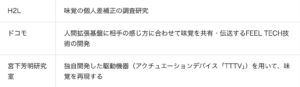
2. Technical Details
① Analyze and quantify the desired taste using sensing devices on the Human Augmentation Platform
② Based on approximately 25 data points regarding the recipient’s taste preferences, estimate their taste sensitivity using a proprietary algorithm on the Human Augmentation Platform
③ Using the data from steps ① and ②, the desired taste is mined on the Human Augmentation Platform to match the recipient
④ Using actuation devices, the five basic tastes (sweet, sour, salty, bitter, and umami) are reproduced using 20 types of standard taste solutions.
3. Application Examples
In the 6G era, mobile networks will feature ultra-high-speed communication exceeding 100 Gbps, ultra-low latency, and ultra-high connectivity. As a completely new form of communication for the 6G era, this technology can be utilized in metaverse spaces and content such as movies and anime. This will enable service providers to offer more compelling content and allow users to enjoy rich, immersive experiences.
In addition to the visual and auditory elements of virtual experiences, it will now be possible to reproduce the taste of virtual food and drinks. For example, users can gather with friends at a virtual café to share a cake or share a meal in a digital space. With 6G networks, these experiences can be enjoyed in real time, anytime and anywhere.
Experiences that previously existed only within movies will become possible. For example, creators will be able to convey the flavors they envisioned—such as futuristic or ancient cuisine—directly to viewers. With 6G networks, these experiences are expected to be available anytime, anywhere, in real time.
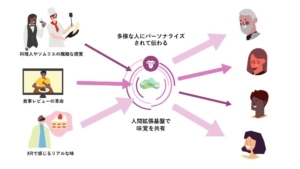
Image illustrating the sharing of taste